Provisions Governing Debentures
A debenture is considered a vital instrument and method of acquiring loan capital by a company. In actuality, a debenture is a loan certificate or bond evidencing that the company is bound to pay a set amount along with interest. Even though the funds raised by the debentures become an integral part of the firm’s capital structure, it does not become a part of the share capital.
Classification of Debentures
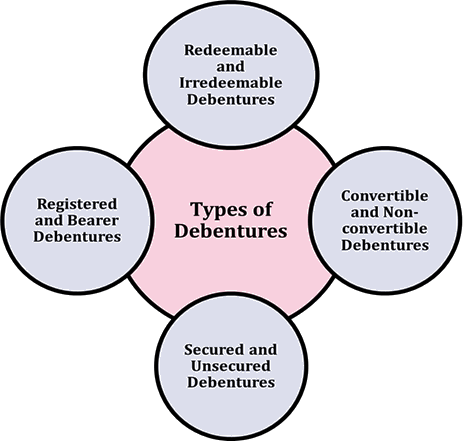
Debentures are classified into different categories, depending on numerous factors such as redemption period, interest rate, coupon rate, etc. Here are some of the most popular variants of debentures:
1. Registered Debentures
In registered debentures, all details regarding addresses, names, and the particulars of holding of the respective debenture holders are filed and stored in an official book or register kept and managed by the enterprise.
Registered debentures can only be moved or transferred by performing a generic transfer deed. Moreover, only the holders have the authority to redeem registered debentures. Hence, such debentures are easily transferrable. However, registered debentures can only be transferred if provisions stated under the Companies Act, 2013, are fulfilled.
2. Bearer Debentures
Bearer debentures are a variety of debentures that can be transferred from one entity to another by the method of delivery. Moreover, the company does not store official records of the holders.
The interest charged on the debenture is paid to the individual who produces the interest coupon attached to such debentures.
3. Secured Debentures
Secured debentures are types of debentures secured by a specific charge on a company’s assets. Also referred to as mortgage debentures, the holders of secured debentures hold the power to recover the principal amount and a higher amount of interest out of the assets mortgaged by the company.
In the case of secured debentures, the company makes a default in payment. Moreover, the debenture holders hold the right to recover uncleared dues from the property they have mortgaged or pledged as collateral.
4. Unsecured Debentures
An unsecured debenture refers to a type of debenture where agreements regarding the debenture’s terms and conditions are outlined. Moreover, customers are not required to pledge any asset as collateral to acquire the loan.
Since no asset is required to be used as security, unsecured debentures often feature a high rate of interest.
With unsecured borrowing, lenders face significant risk. However, to mitigate it, they often ask for a personal guarantee before issuing the loan capital.
5. Redeemable Debentures
A redeemable debenture refers to a written agreement regarding a loan that the lender must repay by a set period of time. Most redeemable debentures feature lower interest rates and more extended time frames for repayment of the borrowed amount.
Redeemable debenture agreements cover the precise time and method of repayment that debenture holders are bound to follow.
6. Non-redeemable Debentures
Irredeemable debentures also referred to as non-redeemable debentures, are debentures that cannot be redeemed during the issuing company’s lifetime. In simpler words, non-redeemable debentures can only be redeemed when the issuing company gets dissolved.
Another instance when irredeemable debentures can be redeemed is when they reach their expiry date or if the issuing firm is ready and willing to return the borrowed loan capital.
Irredeemable debentures do not feature a specific maturity period or date. However, issuers hold power to callback callable debentures. Non-redeemable debenture holders are entitled to receive interest on such debentures.
7. Convertible Debentures
Convertible debentures are long-term debts issued by financial institutions. They can be converted into equity shares after a certain period. Partly convertible debentures are also a variant of convertible debentures.
Fully convertible debentures do not involve any underlying collateral backing up the borrowed loan capital. Since convertible debentures are long-term debts, they pay significant interest to debenture holders.
Convertible debentures can also be exchanged for acquiring stocks at specified dates or periods. This feature of convertible debentures provides debenture holders with some much-needed security since investing in non-secured debentures often comprises many risks.
8. Non-convertible Debentures
As the name suggests, non-convertible debentures are debentures that cannot be converted into shares or equities. This type of debenture is used as a tool to raise long-term funds by firms and organizations through a public issue.
The interest of a non convertible debenture is generally paid monthly, quarterly, semi-annually, or annually. Moreover, such debentures also feature a fixed maturity period.
Non-convertible debentures offer debenture holders top-notch returns, involve low risks, and have higher interest rates as compared to convertible debentures.
9. First Debentures
First debentures refer to a type of debenture which is repaid to the issuer before other varieties of debentures.
10. Second Debentures
A second debenture refers to the variant of a debt instrument paid back after the first debenture is cleared by the debenture holder.
Advantages of Debentures over Shares
There are numerous advantages of opting for debentures over shares. Here are some of the most prominent ones:
It facilitates in avoiding ownership dilution
The majority of the companies raise funds by issuing shares. Even though it is an effective method of raising funds, every time a company issues shares, it dilutes the company’s ownership. On the other hand, debentures are deemed a company’s debt, i.e., they do not provide holders any ownership rights.
Hence, if a company opts for issuing debentures instead of shares, it facilitates them to prevent ownership dilution. Moreover, even though earnings per share or EPS will be impacted, the impact is fixed. Furthermore, it is measured since debentures feature a fixed rate of interest.
It is an effective method of temporary financing
In the case of any company or firm, shares are considered permanent security instruments, meaning that once the company issues shares, they cannot be called back or redeemed. On the other hand, debentures are easily redeemable.
Debentures can be issued by a company whenever there is a requirement for funds, and they can be paid back whenever the company has surplus amounts of funds. Moreover, the company also has the option to call for the redemption of debentures before the arrival of the maturity date. Hence, issuing debentures is an effective method of temporary financing instead of shares, which offers a more permanent solution.
It helps in managing and maintaining a company’s ownership structure
Since shareholders own a certain percentage of a company, they have the right to speak up regarding its ownership structure. For instance, if the company issues new shares and they are bought by new shareholders, there will be a shift in the ownership paradigm, i.e., the ownership structure will change.
On the other hand, if the company issues debentures, individuals who purchase it will not be deemed, shareholders. Hence, it will not affect the ownership structure in any way whatsoever.